Mentava Review: A $500/month Case of EdTech Malpractice
Frequently Asked Questions: This optional section addresses the most common questions that interested parents and educators have when looking for the information on this page.
-
Should I use Mentava to teach my child to read?
- No. Mentava is based on outdated phonics methods that ignore the most important findings of the science of reading. It focuses solely on decoding skills and publicly admits that they believe that fluency will develop on its own with age and practice. They are unaware that children can go through their entire program, appear to succeed at decoding, and still fail to develop true fluency. This puts their students at risk of developing invisible reading difficulties that will manifest in later grades. This is bad enough for the alternatives that Mentava recommends, all of which share the same flaws. When considering their price of $500/month, it is simply negligent for anyone aware of these facts to recommend Mentava.
-
How can you be so sure of this?
- Their blog contains a post that reveals their complete ignorance of orthographic mapping and their failure to find any research on this topic. Orthographic mapping is not some niche topic; it is the single most important and well-established finding in the science of how word-level reading develops. Its power is such that it can easily explain most of the results and risks about this product, which the following questions will elaborate on.
-
Why does that matter?
- Orthographic mapping is the process by which readers store representations of words in their long-term memory for instant and effortless retrieval. Without this ability, children might be able to decode and even read simple material, but they will struggle to develop true reading fluency and comprehension of more complex texts.
- This process is dependent on phonemic awareness, the ability to identify and manipulate individual sounds in words. Mentava, like most phonics programs, teaches phonics in a way that does not develop phonemic awareness properly. As a result, when these phonics programs go through a controlled trial, the results are far inferior to those of interventions who explicitly develop phonemic awareness to proficiency.
-
Wait, so phonics does not work?
- Phonics is necessary but not sufficient. Without developing phonemic awareness, phonics instruction fails to deliver true fluency to a significant portion of students, does not prevent or correct reading difficulties, and is inefficient for those who do learn to read with it.
- When a phonics program is designed with phonemic awareness in mind, it can deliver superior outcomes, fix most reading difficulties, and do it all more efficiently without a complicated set of rules. When phonemic awareness is in place, a student only needs to be exposed from 1-4 times to store a new word in their long-term memory.
-
How does Mentava fail to develop phonemic awareness?
- It teaches blending, a core phonemic awareness skill, but it does so by using letters from the beginning. This turns this exercise into a phonics exercise. The difference is that phonemic awareness exercises can be done with eyes closed. By showing letters from the beginning, Mentava allows some students to unconsciously mask their deficits by relying on their letter-sound knowledge without developing phonemic awareness.
- Students that mask in this way are known as "compensator types" and they are at high risk of developing invisible reading difficulties that will manifest in later grades.
- Other phonemic awareness skills that are known to be important for remediating reading difficulties are completely absent.
-
What about all the games that are supposed to help with motivation?
- Mentava believes in a simple equation for literacy instruction: curriculum + motivation. However, no amount of bad instruction plus motivation can develop phonemic awareness in the students who need it.
- Since the curriculum is flawed, the amount of motivation needed to make students go through it is revealed to be needed to keep them focused on tasks that do not develop the right skills needed for true reading fluency.
-
But what about all the videos of reading toddlers?
- Because of widespread ignorance of orthographic mapping, Mentava believes that these videos of toddlers decoding words are proof of their product's effectiveness and should place them above the need for validation via a controlled scientific trial. In reality, we already know that young children with developed phonological cores can learn to decode earlier than their peers. Some children in these videos might also be "compensator types" who will appear to read well now but will struggle in later grades. Who knows? The company certainly does not.
- However, the strong selection effects of charging $500/month means that most of their customers' children grew up in a rich oral environment that developed their phonological and phonemic awareness from a young age. These children were already primed for success before they started using Mentava for reasons that have nothing to do with Mentava itself and of which the company is completely unaware.
-
So is Mentava a scam?
- Not in a legal sense of the word. It promises an outdated phonics program through a gamified interface and delivers on that promise. Its issues stem from thinking that the outdated programs on which it is based are the pinnacle of reading instruction.
- However, charging $500/month for a product that ignores the most important findings of the science of reading is a questionable decision. There is some deception involved, even if the company is unaware of it, because it puts its students at the risk of developing invisible reading difficulties that will manifest in later grades.
-
Why is Mentava so expensive?
- Its approach is based on outdated phonics methods that are inefficient and require lots of labor to be delivered correctly. Mentava tries to automate this process, but it is very expensive to do so with games and animations, each of which require significant time and effort to develop. The company is unaware of the existence of better, more efficient, and cheaper approaches based on the science of reading.
- Because of their ignorance of the mechanisms of reading development, they spent many resources on trying to solve "problems" (like letter reversals) that are all merely symptoms of phonemic awareness deficits. Those resources could have been better spent on developing a product that trains the right skills needed for fluent reading.
- All of this results in a brittle approach that requires white-glove support. In addition, their funding comes from venture capitalists looking for outsized returns. All of these factors contribute to a high cost of development that is ultimately passed on to the customer.
-
So what is a proper alternative to Mentava?
- For the early stages of reading that Mentava is targeting, children should learn to read with a program that focuses on developing phonemic awareness explicitly, teaches phonics (through simple mapping of letters to sounds, not complicated rules) and provides extra work for those with phonemic awareness deficits. When children are taught in this way, most reading difficulties are prevented or corrected before they snowball into more severe problems.
- There are not many available programs that follow these principles. Heggerty and Equipped for Reading Success are two examples of curricula that do so. However, they are targeted at educators, not parents.
- Pictures Are For Babies is based explicitly on these interventions and packages them into a software tutor that parents can use to teach their children to read effectively without prior experience and minimal training. The Lite version is free with no time limits and covers the majority of the material Mentava charges $500/month for.
-
Do I need to read the rest of this article?
- If you are satisfied with the answers provided in this FAQ, then no. However, if you want to understand in detail why Mentava's ignorance of the science of reading leads to its flaws, how it places its students at risk, how its narrative promotes dangerous misconceptions about literacy, and how this ignorance directly led to its exorbitant price, then please read on.
Mentava is a tablet app that teaches children to decode words up to the K-2 level using a standard phonics curriculum that is not much different from earlier phonics programs from the 1960s and from low-cost competitors, all of which share the same fundamental flaw: a complete ignorance of the most important findings of the science of reading and of how fluent reading develops. Two strategies have been deployed by the company to distract from this fact: its price of $500/month (the price is so exorbitant that it is common to state in discussions that this price is indeed not a typo) and a marketing narrative centered around the idea that the app will unlock the hidden genius of their customers' children and revolutionize early literacy education.
If the public were aware of the scientific consensus on how fluent reading develops, I could have simply pointed out a few sentences in their marketing copy and everyone would have instantly understood why the price and the narrative are completely unjustified. For those without much time, the FAQ at the top of this page should be enough to get the gist of this review. Those who wish to read on only really need to read the section titled Teaching Reading IS Rocket Science. The rest is needed because of the aggressive tactics used by the company to argue against criticism and the need to put its product through scientific evaluation. Those still convinced that Mentava knows more than the "experts" it constantly derides should read on. In reality, the founder, company, and product are completely ignorant of the existence of the real experts, let alone of the most basic concepts of their body of work.
The table of contents below provides a guide to navigate this review.
- Introduction: Some clarifications on why this review is needed, and the criteria used to judge Mentava.
- Meet the Wario to My Mario: How I discovered Mentava, what made me investigate it in detail, and how I found the smoking gun that reveals its fundamental ignorance of the science of reading.
- Teaching Reading IS Rocket Science: A crash course in orthographic mapping, phonemic awareness, and how Mentava's ignorance of these concepts leads to flaws that put its own success cases at risk of developing invisible reading difficulties that will manifest in later grades.
- I am Sorry to Inform You that Your Toddler Is NOT a Genius: An explanation of why Mentava has happy customers despite its flaws, how these results are not revolutionary but expected, the strong selection effects caused by its pricing, and how it puts some of its students at risk.
- You Merely Adopted the Dark; I Was Born in It, Molded by It: An analysis of Mentava's marketing narrative around early acceleration, and how its ignorance of orthographic mapping directly translates into a product that cannot cash the checks it writes in its own marketing. Mentava is then compared with a product that can make those claims but chooses not to do so because of the personal and ethical implications of marketing literacy as an "elite" skill.
- John Coltrane Does Not Want To Play Mobile Games: An investigation of Mentava's claims of adaptive learning and gamification. The limitations of this behavioral approach are contrasted with a cognitive approach based on deliberate practice and mastery learning that models how experts reach the top of their fields.
- Those Who Can, Do; Those Who Can't, Get Funding: An analysis of how Mentava's use of outdated phonics methods and its funding directly leads to its exorbitant price. Their approach is contrasted with a product that costs orders of magnitude less and follows the scientific consensus of the field. This is followed by a reassessment of their claims of being a luxury product.
- Lessons To Be Learned: A summary of the main takeaways from this review for parents, educators, entrepreneurs, investors, and Mentava itself.
- A Tale of Two Plumbers: A final word on how Mentava steered off course when they believed their first instincts instead of following the scientific consensus of the field. This is followed by a revision of the Reading Wars in light of the findings of this review and why deploying Mentava in schools will simply rehash the same old battles.
Introduction🔗
Mentava's price and marketing have naturally attracted significant attention from parents, educators, and investors, both positive and negative. Existing critiques of Mentava have largely fallen flat because they focus on the wrong targets: the price tag, the elitism of the marketing, the real or imagined politics of its founder, or the supposed impossibility of teaching very young children to decode. This review will take the much different approach of taking Mentava at its word and examining whether the product delivers on its promises and marketing. The answer is a resounding no, because of fundamental flaws that went unnoticed to most critics and supporters alike: the product misunderstands the very nature of reading, how fluent reading develops, and how its pedagogy is putting some of their current "success" cases at risk of developing invisible reading difficulties that will manifest in later grades. Talk about a head-start!
Before diving into this review, I will clarify a few points.
- The target audience of this review consists of two groups:
- Parents deciding whether to purchase Mentava and any past, present, and future customers who may be wondering what the high price is actually paying for.
- Educators, researchers, and policymakers who are the target of the company's public attacks on their profession, expertise, and integrity. Given that those attacks are intended to prime the stage for the introduction of Mentava into public school classrooms, providing them with all the evidence and arguments needed to defeat any incursion of this flawed product into the public sphere is a matter of public interest.
- I have not tried Mentava myself, nor do I intend to. Instead, my review is based on the publicly available information about Mentava, including its website, marketing materials, blog posts, third-party reviews, and the founder's public statements. As it will become clear by the end of this review, those alone provide enough material to conduct a thorough investigation on the product's merits and flaws. Most of the issues stem from taking inspiration on outdated phonics methods that are not in line with the current scientific consensus of the field, so trying the product is not necessary to identify them. Ultimately, if Mentava does not have to read the literature of the field to charge $500/month, I do not have to try it to review it.
- My review is primarily focused on its methodology and how its marketing spreads outdated myths about literacy for the sake of justifying its price. It is not intended to be from the perspective of a child using Mentava or from the perspective of a parent and educator considering purchasing Mentava. Instead, it is written from the perspective of a designer and builder of literacy software who has acquired a deep understanding of the field in the process. As such, I am able to provide a more informed and nuanced critique than what has been previously published.
- The only reason I can write this review is that I am the maker of a literacy software tutor. To avoid making this review sound like an advertisement for my own product, I will refrain from mentioning it except when strictly necessary.
- One of the existing objections to critiques of Mentava is that academics cannot understand the complexities of building software and that they are stuck in an ivory tower while Mentava solves real problems. In light of this, my experience as the builder of a literacy software tutor allows me to escape this particular counterargument.
Meet the Wario to My Mario🔗
Have you ever had the experience of encountering someone so similar to you and yet so different that it feels like meeting the Wario to your Mario? While doing research for Pictures Are For Babies, the literacy software tutor that I am building, I came across Mentava, a product that seemed to share many of the external signifiers of my product.
Just like Pictures Are For Babies, Mentava is a software tutor designed to teach children to master reading. And yet, their idea of mastery is being able to decode words at the K-2 level. Just like my own software, Mentava claims to be based on the correct way to teach reading. And yet, their understanding of how that is supposed to look like is not much different from outdated programs from the 1960s. Just like my own software, Mentava claims to harness the power of adaptive learning to provide a personalized learning experience. And yet, as far as I have been able to tell, their curriculum is a linear list of exercises that provide personalization in the same way that letting children go through a textbook at their own pace does.
While building Pictures Are For Babies, I have found many competing products, but I do not usually spend much time looking at them in detail. They are simply too many and most of them follow similar beats. This time, however, I had to stop when I saw their price: $500/month (again, not a typo). At that moment in time, I was debating internally whether charging $10/month was too much, so seeing a product that charged 50 times that amount was simply mind-boggling.
As the length of this review indicates, I have spent more time than I care to admit looking into this product. Either I was missing something, in which case a thorough investigation would reveal a valuable secret, or this product and its pricing are indeed as outrageous as they seem at first glance, even to their own target market of affluent parents and to some of their own customers. After some digging, I finally found the smoking gun. It was hidden in a blog post innocently titled "Developmental milestones for early reading"). I gasped when I read it, but I must warn you that you will be disappointed at first. Without further ado, here is the quote:
48 months: Orthographic mapping🔗
This is the process by which the brain begins to store an entire word as a single unit so that it doesn’t have to be sounded out every single time. While we haven’t found any definitive research on the topic, our observational sense is that this ability to perform orthographic mapping is an even later developmental milestone.
In other words, if you have an extremely early reader pushing the edges of their developmental abilities, don’t be surprised if they continue sounding out every word for an extended period of time. Don’t worry, fluency will develop with age and practice!
While doing research for this review, I ran into a recent tweet by the founder that proves that the product's ignorance of the most important findings of the science of reading is still an ongoing issue. Here is the tweet:
Yeah we’ve already run into issues where a school wanted Mentava to teach “phonemic awareness” But phonemic awareness (as it’s usually taught in schools) doesn’t help kids learn to read, so we don’t
To really understand why these quotes are so damning, I will have to give you a crash course in the science of reading in the next section.
Teaching Reading IS Rocket Science🔗
Let us start this crash course by explaining the concept of orthographic mapping, first through the blog's definition.
48 months: Orthographic mapping🔗
This is the process by which the brain begins to store an entire word as a single unit so that it doesn’t have to be sounded out every single time.
Orthographic mapping is the process by which readers store stable representations of words in their long-term memory for instant and effortless retrieval. The blog's definition is wrong in two minor ways:
- Orthographic mapping is not a developmental milestone that appears at a certain age. It is a cognitive process that continues in all readers all the way to adulthood as they acquire a sight vocabulary that spans tens of thousands of words.
- Orthographic mapping is not a process by which the brain begins to store words. It is the final stage of the acquisition of a word.
The next sentence is the smoking gun:
While we haven’t found any definitive research on the topic, our observational sense is that this ability to perform orthographic mapping is an even later developmental milestone.
Not only is there definitive research on orthographic mapping, but it is the single most important and well-established finding in the entire field of the science of reading, at least when it comes to word-level reading. Its explanatory, predictive, and corrective power has allowed us to answer so many questions that it could be thought of as the unified theory of its field. Some of these questions include:
- Why do some children have word-level reading difficulties?
- Why do some students reverse or omit letters when reading or writing?
- Why do some students effortlessly acquire reading skills, even when exposed to minimal reading instruction?
- Why do students struggle with reading comprehension?
- Why do some students that previously appeared to read well suddenly start struggling with reading comprehension as they progress to higher grades?
- Among many others
How does orthographic mapping work and how it enables fluent reading? Let us start by using another quote from their blog:
12 months: Developing phonemic awareness🔗
At this age, kids are still learning to recognize and differentiate the sounds of the spoken language, although it will be several more years until they learn to make some of the most difficult sounds (like “th” and “r”). This is the ideal age to introduce our free Alphabet Sounds book.
The blog makes another mistake here by suggesting that phonemic awareness is a developmental milestone that occurs at 12 months of age. In reality, they meant to write phonological awareness, which is a more general term. Phonological awareness is the cognitive ability to recognize and manipulate the sound structures of spoken language, including syllables, onsets (starts of words), rimes (the end of words), and phonemes (individual sounds). Phonemic awareness is a subset of phonological awareness that specifically focuses on the ability to identify and manipulate individual phonemes in spoken words and develops later than the blog's timeline.
What's the big deal about phonemic awareness? After all, the founder thinks that "phonemic awareness (as it’s usually taught in schools) doesn’t help kids learn to read". In reality, phonemic awareness is the single most important predictor of a child's ability to learn to read and is the main driver of orthographic mapping. The push in schools to teach phonemic awareness is a direct response to the National Reading Panel's findings that early phonemic awareness instruction is one of the most effective ways to prevent and remediate reading difficulties. This report is the bedrock of the movement to implement evidence-based reading instruction in schools, yet Mentava's ignorance is so complete that they assume schools are in the wrong when they request that Mentava includes phonemic awareness instruction. Through developing phonemic awareness, children progressively gain the abilities to perform the following tasks:
- Segmentation: Breaking down words into their individual phonemes. For example, the word "cat" can be segmented into the phonemes /k/, /æ/, and /t/.
- Blending: Combining individual phonemes to form words. For example, blending the phonemes /k/, /æ/, and /t/ results in the word "cat".
- Substitution: Replacing one phoneme with another to create a new word. For example, changing the /k/ in "cat" to /b/ results in the word "bat".
- Deletion: Removing a phoneme from a word to form a new word. For example, deleting the /k/ from "cat" results in the word "at".
- Reversal: Reversing the order of phonemes in a word. For example, reversing the phonemes in "cat" results in the word "tac".
When this ability develops normally, children can then receive phonics instruction, which simply means that the mappings of letters to sounds are explicitly taught to them. This does not require a set of rules and exceptions as is commonly believed. With a developed phonemic awareness, simple mapping of letters to sounds and repeated exposure allows them to efficiently store a representation of that mapping in their long-term memory. This works even in phonetic languages with a deep orthography like English, where the same letter or combination of letters can represent different sounds in different words. The brain does that by only needing to store the mapping of the letters and sounds that break the existing representation of words already stored in long-term memory. For example, to store the word "have", the brain only needs to store the mapping of the letter "a" to the /æ/ sound, since the mappings for "h", "v", and "e" are already known from other words.
With repeated exposure to the text in various contexts, eventually children can learn to recognize thousands of words by sight and gain the ability to learn new words through their own reading, a process known as the self-teaching hypothesis. By the time they reach adulthood, this vocabulary is tens of thousands of words and allows them to engage with complex reading and writing tasks without being burdened by identifying single words. This, more or less, is how fluent word-level reading is acquired in typical readers.
What about struggling readers? In most cases, the main cause of their reading difficulties stems from a deficit in their phonemic awareness. Without a solid foundation in phonemic awareness, these students struggle to efficiently store the mappings of the words they encounter. Mentava's blog posits a very different idea of reading development:
In other words, if you have an extremely early reader pushing the edges of their developmental abilities, don’t be surprised if they continue sounding out every word for an extended period of time. Don’t worry, fluency will develop with age and practice!
Oh, you should worry, since fluency is the actual goal of reading instruction and a reading intervention that leaves this to chance simply does not understand how fluency develops. The supposedly groundbreaking results their students are getting are simply the first stage of a process that by itself does not guarantee true mastery of reading, the result that the customers paying them $500/month think they are getting. While it is true that a large proportion of children will develop fluent reading skills with age and practice, the remaining will not unless they receive correct instruction focused on correcting their deficits in phonemic awareness. Without instruction that targets the underlying causes of their reading difficulties, more reading and phonics instruction will only lead to more frustration and failure.
Mentava's public materials do use the term blending, which is one of the key skills of phonemic awareness that was mentioned earlier. However, they do not understand the basics about how to teach it. For one, they believe that blending is a developmental milestone that appears at a certain age. In reality, blending and all the other phonemic awareness tasks are cognitive skills that can be trained and improved, even at later ages. They also mistakenly believe that decoding fluency is a guarantee of developing actual reading fluency. This is the real danger of Mentava's approach: they are unaware that children with underdeveloped phonemic awareness can learn to decode words and graduate from their program without having developed the necessary skills to become fluent readers.
All these errors stem from Mentava's inspiration from Direct Instruction and Orton-Gillingham methods, thinking these methods to be the pinnacle of reading instruction. In reality, these methods have only proven mild effectiveness in controlled scientific trials compared to reading interventions that develop phonemic awareness explicitly and all the way to proficiency. Like these outdated phonics programs, Mentava does not understand the difference between a phonics exercise and a phonemic awareness exercise. If you are unsure about the difference, simply ask yourself if the exercise could be done with eyes closed. If it cannot, then it is not a phonemic awareness exercise. Correct instruction should first ask students to perform blending through auditory and oral exercises, then instruct them on the mapping of the letters to sounds.
By teaching blending entirely with the aid of letters, Mentava is teaching phonics, not phonemic awareness. By showing letters during these exercises form the beginning, Mentava introduces the possibility that the student will unconsciously mask their deficits by relying on their knowledge of letter-sound mappings instead of truly developing their phonemic awareness. There is in fact, an entire category of children with reading difficulties known as "compensator types" who do exactly this. These children appear to be learning to read. When these children are given explicit instruction in phonics, they can use that knowledge to read texts with effortful decoding. Because the texts they are assigned are simple, predictable, and deal with concrete topics, they can even show signs of reading comprehension and receive little attention from their parents and teachers. However, when these children reach higher grades, the greater demands of the texts places greater stress on their limited to non-existent sight vocabulary, leading to a sudden and dramatic drop in their reading comprehension skills. This phenomenon is so well-known that it has its own name: the fourth-grade slump.
Another major mistake of Mentava's approach is the complete omission of the other phonemic awareness tasks mentioned earlier: substitution, deletion, and reversal. The ability to perform these tasks develops on its own in children who gain fluency normally. In children with reading difficulties, however, explicit instruction in these tasks provides the necessary extra practice to improve their phonemic awareness to the level needed to catch up with their peers. When these interventions are performed early, most reading difficulties are either fully prevented or corrected before they snowball into more severe problems and academic failure. Just like in the case of blending and segmentation, these tasks must be taught without the aid of letters to ensure that true phonemic awareness is being developed.
Mentava commits many of the same mistakes of the genre, so its faults are in no way unique to it. However, when the price and the rhetoric about other similar apps being "edutainment", "scams", and "slop" is factored in, it is simply baffling that such a product would be built without any simple review of the existing literature of the field. It is not that Mentava is aware of this research and has consciously decided to go in a different direction. It is clear from their public materials, this blog post being the most outright of them, that they are simply unaware of the most basic and well-established findings in the science of reading. This ignorance contributes to many of its follies, its high cost of development, and ultimately to its exorbitant price.
Since I am the builder of a literacy software tutor, let us use my experience as an example of how to properly design one. Just like Mentava's founder, I started with the assumption that my own product would be more or less what you typically expect from a phonics program. However, just before I decided to start building it, I decided that I needed to do a thorough review of the field, not expecting to find anything that would significantly change my approach. Finding the correct books took no more than a few hours of searching online. Buying them took a fraction of Mentava's monthly price. Understanding them, humbling myself at the depth and breadth of the field, and synthesizing them into a coherent whole that could be implemented into the design of Pictures Are For Babies took me much longer, but it ultimately led to a product that is radically different from my original intuition, much easier to produce, and follows the most effective reading interventions. Those interventions have shown that over 90% of students can learn to read and write to grade level with correct instruction.
My choice to title this section "Teaching Reading IS Rocket Science" is not accidental. It is the title of a seminal article by Dr. Louisa Moats, one of the pioneers in the science of reading. In it, she urges educators and policymakers to recognize the complexity of teaching reading, to reject simplistic approaches, and to follow the scientific consensus of the field. In her own words:
This we know: reading failure can be prevented in all but a small percentage of children with serious learning disorders. It is possible to teach most students how to read if we start early and follow the significant body of research showing which practices are most effective. Students living in poverty, students of color, and students who are eligible for remedial services can become competent readers—at any age. Persistent “gaps” between more advantaged and less advantaged students can be narrowed and even closed. Fundamentally, these gaps are the result of differences in students’ opportunities to learn—not their learning abilities.
If the public were familiar with this consensus, that paragraph alone should have prevented Mentava from gaining any traction. Alas, the gap between the scientific consensus and practice that Dr. Moats laments still exists, and Mentava is happy to propagate the same myths to justify its price and marketing narrative. As the perfect example, the other reason for choosing the title is that Mentava's founder has publicly stated that "teaching reading is NOT rocket science". In his mind, reading is a simple skill that involves memorizing 50 or so sounds and their corresponding letters. His conviction is so strong that the phrase is featured on their homepage at the time of writing this review. As I have fully demonstrated in this section, nothing could be further from the truth. His complete ignorance of the field has turned the tagline of his supposedly brilliant insight into a devastating knockout blow.
I am Sorry to Inform You that Your Toddler Is NOT a Genius🔗
Which leads us to a simple question: If Mentava is so obviously flawed, why does it have happy and satisfied customers? In public, the founder has stated that the results his customers are getting are the reason that any critics can be dismissed. He has gone so far as to say that research is not needed because of a few videos of toddlers effortfully decoding. The marketing, testimonials, and the founder's public statements are all fully aligned to showcase video after video of toddlers decoding words. We are supposed to believe that before Mentava, no young children were able to gain decoding skills and that these videos are proof Mentava is above scrutiny. This is a very convincing argument to his customers and to his Twitter followers, many of whom are in the search for better educational outcomes for themselves and their children. There is nothing wrong with that, despite the objections of some earlier critics.
So two questions arise: Does Mentava work and if so are those results revolutionary? The simple answer to the first question is that for the most part, Mentava is delivering what it promised its customers: a software version of an old-school phonics program that teaches decoding skills. By their own public admissions, they are not addressing fluency, spelling, vocabulary, reading comprehension, or writing skills. It simply delivers similar results to other phonics programs and reproduces their exact weaknesses, albeit at a much higher price. The founder himself has stated that he thinks of his product as a luxury item for affluent parents who can afford to pay for it. There is deception involved, even if the founder does not seem to be aware of it himself. By portraying reading as a simple and easy skill that takes only months to acquire, he is able to sell the results of the very first stage of reading development as a grandiose achievement that will unlock the potential of its customers' children. Mentava's customers paid a premium because they believed that their children's eventual mastery of reading and writing skills was being guaranteed by the product.
We can use our newfound knowledge of the science of reading to easily answer the second question: Are Mentava's results revolutionary? The simple answer is no. By simply looking at the price and the available testimonials, one can see that Mentava's customers are mostly affluent parents who can afford time and money to invest in their children's education. The vast majority of their children would have learned to read with any method or sometimes without any method at all and mere exposure to books and reading. The number and quality of the words that children are exposed to have been found to be strongly correlated with socioeconomic status. Being exposed to an orally rich environment from an early age develops strong phonological and phonemic awareness, which are the biggest predictors of reading success. Mentava's students were primed for success before they even started using the product for reasons that have nothing to do with Mentava itself and of which the company is completely unaware, instead believing that their proprietary blend of games, motivation hacks, and a phonics curriculum from the 1960s are a breakthrough in the field of literacy education.
But surely, a two-year old decoding words is something special, right? Not really. The company takes advantage of the large variance in the developmental milestones of young children to market the results of their youngest students with the most developed phonological cores as proof of their product's effectiveness. The literature on orthographic mapping is already aware that such children exist and that they learn to read earlier and more easily than their peers. However, one cannot extrapolate the results of a few outliers to the entire population and these large variances in development go away as children grow older. As a personal anecdote, I could barely speak at two years of age, yet I went on to teach myself to read without much formal instruction at the age of four.
For a few of Mentava's happy customers, however, the outdated pedagogy and the sole emphasis on phonics and decoding can lead to invisible reading difficulties that the student learns to mask and compensate for. These students will appear to have been accelerated in their reading development, but their progress will collapse in higher grades, years after they have stopped using Mentava. Neither the founder nor the employees will be around to help them when that happens. While the selection effects of charging $500/month are strong enough to prevent this from happening to most of their customers, individual customers will not know if their child falls into this group until it is too late. While I do not care about a few children whose parents will be able to afford the professional help needed to correct their reading difficulties, I do care about the implications of deploying Mentava into public school classrooms, where its shortcomings will be readily apparent when their marketing meets the reality of children with underdeveloped phonemic awareness, some of whom will be suffering from other complex life situations and learning disabilities that further endanger them. The founder's continued attacks on educators and public education are designed to prime the sentiment for the rejection of evidence-based literacy instruction in favor of his flawed product.
The complete ignorance of the science of reading in the part of Mentava and the public explains why these completely expected results are being misinterpreted as revolutionary by its founder and supporters, and as some impossibility or affront to other children by some of its critics. More competent critics have rightly pointed out that their own children learned to decode words at the same age with the use of much cheaper phonics programs that work and look much more similarly to Mentava than what the marketing would like you to believe. And, as will be explained in the section detailing the app's high development costs, Mentava's choices make it less effective than interventions based on the most up-to-date consensus in the field. Their children succeeded in spite of these choices because, as the science of orthographic mapping has already shown, most of these children would have succeeded at learning to decode words with any barely competent method or sometimes without any method at all.
Who Mentava is not for is equally revealing. The founder has publicly stated that Mentava is not for older children who have already received bad reading instruction at school or for those with reading difficulties. The stated reason for the first exclusion is that the "correct" instruction received through the app cannot make up for bad instruction at school. The stated reason for the second, is that they are focusing their efforts on the "smartest" children and do not have time for any other segment of the market. As the previous section explained, the real reason that their product is fully inadequate for these students is that it is unable to address the underlying causes of their reading difficulties. Had he read and understood the existing literature of the field, he would have found that most of these issues can be addressed with a few dozen hours of targeted instruction focused on developing their phonemic awareness. His haste to disrupt the field and his complete disregard for children with reading difficulties prevented him from discovering a more powerful and effective approach that would have allowed his product to serve a much larger segment of the market and maybe even command the high price it thinks itself worthy of.
In the end, Mentava repackages the phonological head start that their customers' children received from their enriched home environments and sells it back to them at a massive markup. It manages to do so by deploying the next part of their marketing strategy: the narrative that their early reading had something to do with their high general intelligence, and that by unlocking literacy a little earlier than they would have otherwise, their children will be able to unlock their full potential and go on to change the world. Unbeknownst to them, this marketing narrative is currently saving them from the many problems their product will encounter if it is ever put in the hands of many children with underdeveloped phonemic awareness. For any past and current Mentava customers reading this review, I am sorry to be the bearer of bad news, but your child's early decoding skills are not evidence of genius, but of a developed phonological core that was mostly in place before they started using Mentava. Worry not, however. With sustained and deliberate practice over many years, this ability will allow them to easily master reading and writing to an advanced level. As for genius, they will have to work hard for it.
You Merely Adopted the Dark, I Was Born in It, Molded by It🔗
Mentava's marketing copy is quick to provide a narrative for its existence and mission. Mentava is for children who have been marked as "gifted" (either through demonstrating actual giftedness, by developing earlier than their peers, or by being labeled as such by their parents or teachers). In its grand theory of the world, the primary obstacle to these children's success is that they get bored at school because a vast network of "anti-merit" activists, educators, and policymakers are preventing them from reaching their full potential. And if only they were able to learn to read earlier than their peers, they would unlock their potential and go on to cure cancer. That is of course, if their parents can shell out the thousands of dollars required to access Mentava for a few months. The genesis of this narrative is the founder's personal story of his mother having been warned by his kindergarten teacher that he would commit suicide because of his mother was pushing him too hard academically. The founder's early curiosity and ability to take advanced classes led him to study calculus in middle school, ace the SATs, and gain admission to several top universities.
Much of Mentava's criticism centers around this narrative, and the company has an easy time dealing with it. We are told to believe, that all of that criticism is born out of jealousy for people who are part of the "cognitive elite" from people of low intellectual capacity that fear this elite group. However, rather than rehash old criticisms that will only go in circles, let us assume that this narrative is correct, worthy of all the pomp of their marketing and public interactions, and use the science presented in the previous sections to examine all the ways that Mentava fails to live up to it. Let us compare a few questions and assumptions to how Mentava solves them and how a hypothetical product based on the science of reading, writing, and learning would solve them:
-
How to accelerate the literacy development of gifted children?
- Mentava focuses on teaching them to decode K-2 words earlier than their peers through a phonics curriculum from the 1960s delivered through a gamified app. When the child finishes their curriculum in a few months, they are done with Mentava. The development of reading fluency, spelling, vocabulary, background knowledge, reading comprehension, and writing skills is left to chance. The way to accelerate their development is to make them go as fast as possible through this small curriculum.
- The hypothetical product is not only concerned with developing decoding skills up to the K-2 level, but with developing the full range of skills needed to become a fluent reader and writer up to the advanced level. To cover word-level reading alone, it must track the development of a sight vocabulary of tens of thousands of words. Failure to achieve fluency should trigger a tiered intervention that delivers the extra work needed to develop fluency through targeted phonemic awareness exercises. The product must also cover spelling, reading comprehension, and writing skills. This curriculum will take years to complete, but students will leave with the level of mastery of the best adult readers.
-
The product should be able to serve the children with the highest general intelligence
- Mentava excludes children with reading difficulties, wrongly assuming that their difficulties are a reflection of their general intelligence. Reading difficulties, as it's been shown in the previous sections, are mostly the result of deficits in phonemic awareness that can be corrected with targeted instruction. By excluding these children, Mentava fails those in its target market with reading difficulties.
- Ironically, given Metava's promises of helping their customers' children become capable of curing cancer, one of the many geniuses with reading difficulties that Mentava would have excluded is Carol Greider. She won the Nobel Prize in Physiology or Medicine in 2009 for her discovery of how chromosomes are protected by telomeres and the enzyme telomerase.
- A product based on orthographic mapping understands that reading difficulties have nothing to do with general intelligence. By giving these children evidence-based interventions when they fail to develop fluency, it manages to actually unlock their potential, even after years of bad reading instruction.
- Mentava excludes children with reading difficulties, wrongly assuming that their difficulties are a reflection of their general intelligence. Reading difficulties, as it's been shown in the previous sections, are mostly the result of deficits in phonemic awareness that can be corrected with targeted instruction. By excluding these children, Mentava fails those in its target market with reading difficulties.
-
The product should deliver its instruction via proven strategies to optimize learning
- Mentava's main argument for its ability to accelerate learning is its use of adaptive learning and gamification. These two features fall short of best practices, which will be discussed in much more detail in the next section. For now, it suffices to note that Mentava offers a linear series of activities that trick the students to go through them by dangling digital rewards in front of them, and to compare that against the approach presented right below.
- The hypothetical product must track the development of a large sight vocabulary, background knowledge, and writing skills, so a sophisticated mechanism for review and introducing new material is essential. Without it, it won't be too much different from printing tons of flashcards. Many such strategies have been proven to work in the literature of optimal learning and expert performance. They are described in detail in the next section.
-
The product should increase the gaps in achievement between gifted children and their peers
- Mentava believes this is the case, using analogies from sports to make their case. The previous sections already showed that the actual mechanism for fluent reading can be developed in most children with correct instruction. Their ignorance of orthographic mapping turns the gaps in achievement that Mentava boasts in public into yet another proof of the limitations of its product.
- We can turn Mentava's sport analogy on its head. Imagine a world where most children have a similar body and motor skills as LeBron James. In that world, the only difference in their achievement would be due to the quality of their training. When it comes to reading, this is the world we are living in.
- The hypothetical product would develop the reading skills of most children to the level of the best adult readers. Thanks to its sophisticated mechanism for review and introducing new material, it might allow some children to reach that level much earlier than others, but all children with a working phonological core are capable of eventually reaching the end of the curriculum.
- Mentava believes this is the case, using analogies from sports to make their case. The previous sections already showed that the actual mechanism for fluent reading can be developed in most children with correct instruction. Their ignorance of orthographic mapping turns the gaps in achievement that Mentava boasts in public into yet another proof of the limitations of its product.
The second product is not hypothetical. In making my own literacy software tutor, Pictures Are For Babies, I tried to conform to the description of that ideal product as much as possible. Despite matching the very ideals Mentava claims to champion, you will not find any mention of giftedness, acceleration, or elitism in its marketing copy. Its success to match Mentava's own ideals is a direct consequence of building it on top of the science Mentava completely ignored. The reason that I do not market it as such is that I find that narrative personally distasteful. After all, how could I create a product whose pricing and marketing would exclude me, my own mother, and my entire family?
A reader looking at my resume would be inclined to believe that I agree wholeheartedly with this narrative because I was the ideal child that Mentava claims to help. I got bored at school, did not feel challenged, taught myself advanced topics years before my peers, aced the SATs, got into several top universities, received a full ride to all of them, attended MIT, graduated with two degrees in Computer Science, and worked as a software engineer in Silicon Valley. However, I did all of this against the backdrop of generational poverty, illiteracy, and lack of access to education. Mentava's founder is only a temporary guest to the injustices he claims were inflicted upon him. Myself, and my entire family, are lifelong residents. All my grandparents were illiterate, born as peasants in a poor rural area of Mexico that did not get electricity until the late nineties. My parents and all of their siblings only managed to attend an elementary school where a single teacher would teach multiple grades in a single classroom. My mother, the most academically gifted child of her classroom, wanted to continue her education. Her teacher advocated for her to my grandfather, but he refused because he needed her help to tend to the family's herd of goats and sheep.
Pictures Are For Babies is not a monument to my own academic success, a way to get back to my awful 6th grade teacher, nor it is inspired by the needs of bored children. It is dedicated to my grandparents, my parents, my uncles and aunts, and to the billions of children whose educational dreams ended much like my mother's did: hungry and tired under the searing summer sun, tending to the family's herd, while she and her siblings played a game where they would trace the steps my grandma would take to bring them a simple meal of beans, squash, and tortillas. Oh, how they would have enjoyed the torture of being mildly bored in the classroom of an American suburb.
John Coltrane Does Not Want to Play Mobile Games🔗
Having discussed Mentava's pedagogy and marketing narrative, we can now turn our attention to its claims of adaptive learning and using gamification to motivate students. As was done in the previous section, let us take these claims at face value and compare them to best practices from the fields of optimal learning and expert performance.
Mentava comes with a form of adaptive learning, although a very limited form that is far from their marketing claims of being "next-generation" software. As far as I have been able to tell from their materials and screenshots, the app consists of a linear list of exercises that students can go through at their own pace. A more accurate description would be to call it a self-pacing system, but so is the textbook they recommend to parents who cannot pay for their service, a textbook based on the same outdated pedagogy. While there is value in having students go through any sort of linear curriculum at their own pace, this is hardly a breakthrough in educational technology and when compared to the alternative approach described in this section, it falls short of meriting any special mention among the many EdTech products that have claimed to implement adaptive learning but never quite delivered on that promise.
The gamification features of Mentava are more extensive, and featured constantly in their marketing and public statements as part of their "secret sauce". The founder's past work in the mobile gaming industry is the inspiration for this approach. We are told to believe that by using the same gamification techniques that he used in his previous work as a "digital drug dealer" (his words, not mine), he has managed to break the secret code of literacy education: curriculum plus motivation.
Since we are taking Mentava's claims at face value, let us not discuss the validity of this simple model of learning. However, the equation needs some correction because it should be a product, not a sum. This is because the perfect curriculum will be useless without motivation, and motivation with a terrible curriculum will lead nowhere. Mentava claims that the games and motivation hacks are what set them apart from other similar phonics programs by increasing motivation because children hate to go through those kinds of programs on their own.
There is some truth to this claim. Anyone who has opened a mobile game, TikTok or Instagram knows that those companies have mastered the art of keeping users engaged for long periods of time. This model is entirely behavioral and relies on regularly providing users with small rewards that keep them coming back. However, there are two main issues to how Mentava is deploying these strategies inside their software.
The first issue is that the high amount of motivation needed to go through an outdated phonics programs is a direct consequence of using that curriculum. To see why, we need to understand some details of how those outdated phonics programs are implemented. In their textbook or educator-led forms, these programs are mostly a series of repetitive exercises that the student must go through to learn the mappings of letters to sounds. These mappings are taught as a set of rules and exceptions that the student must memorize. Some of them might involve even more complicated concepts like syllable types. The idea is that the student is learning an algorithm that they can apply to any word they encounter to decode it. The problem with this approach is that it is boring, tedious, and goes against the scientific consensus described in past sections. The goal of fluent reading is being able to read words instantly, not developing an algorithm to decode words. The way to gain such fluency is through developing phonemic awareness to proficiency, explicit instruction on the simple mapping of letters to sounds, and repeated exposure to words in various contexts.
The second issue is that these gamification strategies cannot produce long-term mastery. While they might be enough to allow students to go through their curriculum in a few months, these strategies and the behavioral model they represent are not enough to produce the kind of deep, durable, and transferable learning that is required for true literacy. By Mentava's own admission, their product is only concerned with teaching decoding skills to the K-2 level, and they expect fluency to develop on its own long after their customers have stopped using their product. As the theory of orthographic mapping explained, decoding is an intermediate step in the process of establishing stable representations of words in the student's long-term memory. Therefore, Mentava's own software does not produce mastery of the limited skills it teaches. By virtue of its strong selection effects, those children will likely go on to become fluent readers, but the gamification strategies will not be the major contributor to that outcome.
Many of Mentava's critics and prospective customers have expressed skepticism about the use of games and iPads. Some because they do not like their young children using screens, others because they doubt that games can be effective educational tools, others because they do not believe that a theory of mastery based on the same strategies used by casinos to keep gamblers in the same place for hours at a time can be effective for teaching something as complex and important as reading skills. The founder has dismissed these concerns similarly to how he dismisses most of the critiques leveled at his product. Experts who question the wisdom of deploying the strategies of mobile games in a children's literacy tutor are simply "morons". That is not an exaggeration, but a public statement made by the founder. I've chosen to document this statement both in link and screenshot form because I have made claims of the founder dismissing and being aggressive against critics. This particular statement should prove that the founder's insults are indeed that crude. It is also very relevant to the discussion at hand.
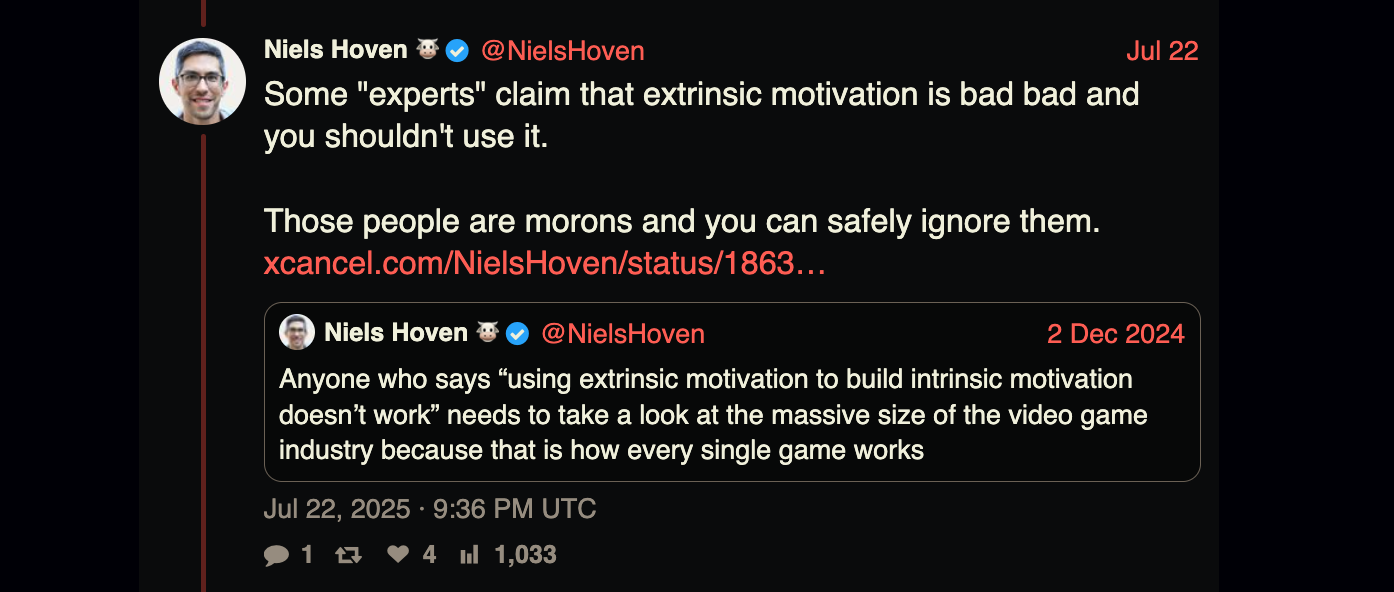
Unfortunately for myself, this wisdom reached me three years into the journey that these "morons" sent me down. You see, I never set out to build a literacy software tutor. I simply stayed out late one night, and decided to shop around for a tenor saxophone. I found a nice instrument made the same year I was born, so I decided to gift it to myself as a birthday present. The problem was that I had no idea how to play it, and I was already learning guitar. In a bout of daydreaming, I fantasized about a software tutor that could help me manage all of my practice sessions. It would give me an exercise, score my performance, and then give me another one based on a vast and structured curriculum and my past performances. Through repeated instruction over years, I would climb the curriculum and eventually become a master of the instrument.
I scoured the Internet for something that could do that, but I could not find anything that came close to my vision. So I decided to build it myself. And who did I find while figuring out how to build it? The "morons" that Mentava's founder so proudly dismisses. The field of expert performance and optimal learning has cognitive model of how mastery is developed that is very different from the gamification deployed in Mentava. In this model, mastery is not the product of innate gift or cajoled by playing games. It is the product of practice that is designed to develop specific skills, with ample opportunities for feedback, reflection, and correction, over a long and sustained period. This process is known as deliberate practice, and is the theoretical foundation of Trane, the practice engine that powers Pictures Are For Babies.
How does this engine attempt to keep students engaged over long periods of time? It mostly shows them exercises that are at the edge of their current abilities, thus ensuring that they are challenged but not overwhelmed; it mixes exercises of different types and difficulties to keep the experience fresh; it shows a small amount of exercises that the student has already mastered, both to ensure that those skills remain fresh and to give the student a small dose of confidence and satisfaction; and it spaces the practice of exercises over time to ensure that the exercises are transferred to their long-term memory. The result is not the sugar rush of the behavioral model, but a state of flow that is characterized by sustained focus, loss of self-awareness, and high intrinsic motivation. The state of flow is the anti-thesis of the addictive state produced by mobile games that Mentava is hoping to replicate. I can confirm from personal experience using Trane to learn math and music, that I often tell myself to do one more exercise, only to find that half an hour has passed, and I have completed dozens of them without noticing the time go by.
In this post-truth reality that we are living in, who is to say who is right? Is it a model of mastery built on the wisdom of mobile game design, or one built on decades of rigorous research in multiple fields? You be the judge. Before you do, however, let me tell you why I chose to name my deliberate practice engine after John Coltrane. He is the perfect namesake for a software based on deliberate practice because he was not born a prodigy. He was not put through any special program to nurture his inborn talent and only picked up the saxophone in high school. After signing up for the Navy, he played in their band, and then climbed up the ranks of the jazz world through relentless practice and dedication to his craft. After quitting heroin cold turkey (the real kind, not the digital kind that Mentava is selling) and a period of isolation, he had a spiritual awakening that fueled his relentless pursuit of mastery even further. For the next decade, until his untimely death at the age of 40, he produced some of the most important and influential recordings of the 20th century, and became a towering figure beyond what most of his contemporaries could have imagined when they first heard him play in his early bands and recordings.
So did John Coltrane become a legendary master because of innate talent, through deliberate practice driven by his intrinsic love of his craft, or did a time traveler from the future manifest in his shed in those days of isolation and offered him a mobile game that would unlock his full potential? To believe in Mentava's grand theory of mastery, one must imagine John smiling, as a cartoon pig throws confetti up in the air and praises him for completing yet another daring scale run.
Those Who Can, Do; Those Who Can't, Get Funding🔗
Out of the many arguments that Mentava has used to justify its price, the most effective one is that it has cost the company over $2 million to develop the app. This argument is effective because it sounds reasonable on its face to most people who have never built a literacy tutor. I am not most people, however. As I hinted out in the introduction, I am uniquely qualified to audit Mentava because I have built a product in the same space, all by myself, at a fraction of the cost. In this section, I will go through many of the questions that arise when building one, how Mentava and Pictures Are For Babies solve those problems, and how their respective solutions contribute to the sticker price of each product. It should be obvious why avoiding mentioning my own product in this section is impossible.
-
How do you structure and organize a curriculum?
- Mentava uses a linear curriculum that introduces skills in order. This sounds reasonable on its face, but because there is no automatic review, Mentava solves the problem of review through designing subsequent lessons to include previously taught skills. This is not a bad solution, but as it will be explained in the next point, it is much less efficient than what an approach built on Trane allows you to do.
- Pictures Are For Babies uses a curriculum that integrates everything from learning individual letters and sounds to reading and spelling sentences of college-level difficulty. Future releases will add reading and writing tracks following the same principles. By using Trane, the complexity of this curriculum can be encoded into a graph of individual lessons and courses that map the development of literacy skills. Because the engine takes care of review, lessons can be designed to focus on teaching one new skill at a time, reducing the complexity of designing individual lessons and allowing for much faster and cheaper curriculum development.
-
Are visuals and games a good idea for teaching reading?
- Mentava seems to think so, believing that reading is a visual and symbolic skill and that games provide motivation, the second part of their equation for mastery. Previous sections have debunked this, but even if we were to accept their premise, the use of visuals and games comes at a high development cost. Creating art assets, animations, and game logic is expensive and time-consuming.
- Pictures Are For Babies understands that fluent reading is mostly a function of phonological awareness, an entirely auditory skill. Therefore, besides the cover image, it employs no visuals at all. Because its reading pedagogy teaches the correct skills and its practice engine ensures that students practice at the edge of their abilities while reviewing past material, there is no need for gamification or extrinsic motivators. This minimalist approach allows for lessons to be defined as simple text files that can be easily created and edited.
-
How do you deal with omitted letters, b/d reversals, and any of the many common mistakes that children make when learning to read and write?
- Mentava believes that these are real problems and that by developing new games and activities, they can engineer a fix. In public statements, the founder proudly proclaims that they are creating novel solutions to problems that educators had no answers to before.
- Pictures Are For Babies understands that these issues are not real problems, and are either non-issues corrected through repeated practice or symptoms of an underdeveloped phonological core. Therefore, it fixes them by training parents in a multi-tiered protocol that focuses on developing the student's phonemic awareness with increased levels of intensity and support for those students that continue to struggle with a lesson. This tiered intervention protocol is inspired by reading interventions that showed that the number of children that can learn to read at grade level with correct instruction is over 90% (this number is actually a conservative estimate because some studies showed even better results).
-
How do you teach phonic rules?
- Mentava claims that it is better than traditional phonics programs because it automates a lot of the work that goes into delivering them. The programs on which Mentava is based do in fact require a lot of work to deliver. They introduce a complicated set of rules and exceptions that use meta-linguistic terms (short vowel, long vowel, silent e, etc.). It is only natural that some parents will choose to pay money they have in spades to avoid the boring and tedious work of learning to deliver these reading programs.
- Pictures Are For Babies does not follow these programs at all. Actual studies done on these programs have shown that they are mildly effective and the literature of the field contains interventions that are much more effective. These interventions do not teach phonics by introducing complicated rules and exceptions. Instead, they teach phonics by simply mapping letters to sounds and relying on repeated exposure and developing phonemic awareness to ensure that those mappings make it into long-term memory. While some training is involved in learning how to perform this type of reading intervention, it is much simpler than learning rules and meta-linguistic terms. Because the protocols are based on phonemic awareness, any fluent reader can learn to deliver them as long as they are willing to learn them, follow the steps, and provide caring support for the student.
-
Who does the teaching?
- Mentava relies on the app to automate the delivery. As the previous point explained, that is a necessity when trying to deliver those types of phonics programs. If you go to their website, you will be met by an image of children using iPads on their own, with no adult supervision in sight. Not only is this suboptimal as will be explained in the next point, but it also drives up the cost of development.
- Pictures Are For Babies relies on a human tutor to deliver the instruction. The tutor's job is much simplified by having the practice engine take care of scheduling and by reducing the complicated set of rules of traditional phonics programs into a simple protocol. This also has the advantage of using the social and emotional connection between the tutor and the student to provide the type of emotional support that Mentava's app has to gamify. Since the teaching is left to a human tutor, the development cost of the app is greatly reduced.
-
How to deal with the demands of sustained practice?
- Mentava understands that practice is effortful, but their solution is to gamify the experience. Again, even if we took them at their word, this comes at a high development cost.
- Pictures Are For Babies also understand that practice is effortful, and it uses two strategies to address this issue. The first is to use its practice engine to deliver an optimized stream of short lessons that can be completed in a few minutes. If the student expresses boredom or frustration, they and their tutor can take a reading break and return to practice later. During this break, the student is read a book of their choice by the tutor. This fosters an organic connection with written material and serves as a way to develop their background knowledge, vocabulary, and oral comprehension skills. The only cost is writing the section of the manual that contains the instructions.
-
How do you let customers try your product?
- Mentava has a 14-day free trial. This is reasonable, but the company cannot give away more time or content because of the shallowness of its curriculum and the high cost of development.
- Pictures Are For Babies has a free Lite version that gives access to the first 200 lessons of the curriculum with no time limit. The contents of the Lite version contain more than half of the content of Mentava's entire curriculum.
-
How do you differentiate your product from the many players in the market?
- Mentava's pedagogy and features are not much different from many players, apart from their emphasis on automating the work and on finishing their curriculum as early and fast as possible. The company itself publicly admits to this. So how do they differentiate themselves in this crowded market? By charging an exorbitant price that draws eyes and deploying a narrative of elite excellence and acceleration. This narrative now can be seen as what it is, a necessity to differentiate an ordinary product in a crowded market.
- Pictures Are For Babies differentiates itself by integrating the current consensus of the science of reading, writing, and learning to create a product that covers the entire journey from learning letters to writing at an advanced level. By integrating a deliberate practice engine, it is able to deliver this curriculum optimally, ensuring that students practice at the edge of their abilities.
-
How do we support our customer?
- Mentava claims to provide "expert" white-glove support to its customers, which is part of the reason that it cannot drop its price. In the face of all the above shortcomings, it becomes clear that the reason for needing this level of support is to paper over the cracks of an app that constantly fights against the actual mechanisms that enable fluent reading and has dancing farm animals taking up valuable space in the student's working memory. Their expertise is not of the science of reading, but of the art of cajoling students to go through their curriculum.
- I provide email support to paying customers and try to support free users of the Lite version as best I can. However, the design of the software and its pedagogy is designed to minimize the need for support. Not because I do not care about my customers, but because my choices are meant to empower them to learn the best known model for teaching their children to read and write and to outsource all the labor needed for planning and scheduling lessons to the software. This is achieved by focusing on the core mechanism of fluent reading, outsourcing the repeated exposure required to its practice engine, and delivering intervention through a single protocol that is extensively documented in text and video format.
-
Who implements all of this?
- Mentava employs a small team of employees to build their app. This is not a value judgement, but rather pointing out the obvious reality that payroll must be passed to the customer. I also would like to make it clear that I do not blame any of their employees for the product's shortcomings. I am aware that an employee of a small startup with a single founder has little power to change the direction of the product. What the founder's role has been in the development of the app is unknown, but we can know for certain that none of his time was spent on integrating the current scientific consensus of the field into the product.
- Pictures Are For Babies is built and maintained entirely by myself. I built the practice engine as a side project over three years. Making it capable of delivering literacy instruction took a couple of days of part-time work. The rest of my time has been spent on researching the consensus of the fields involved, refining my understanding and approach, building the curriculum, coding the user interface, writing the instruction manual, and dealing with administrative tasks.
-
Who funds the development?
- Mentava has raised money from angel investors and a $3 million seed round. This funding pays for the salaries of the employees without which the app would not exist. This type of capital appears easy and cheap to come by at first, but it comes with strings attached, like the need to provide an outsized return on investment to investors and to move quickly in ways that might not align best with what would be best for the product and its customers.
- Pictures Are For Babies has been entirely self-funded and will remain so for the foreseeable future. The development of the practice engine was free since it was a side project that I built in my spare time. I took a part-time contract at my current job to have enough time to build the user interface and the symbol, word, and sentence tracks. I hope to take the plunge to work on it full-time in the near future, which will enable me to work on marketing the software, distributing the free Lite version to educators and parents, and finishing the rest of the curriculum.
-
How many customers are needed to sustain the business?
- Mentava needs both many customers and a high price to sustain its business model. Failure to meet either of these requirements would make the company go out of business.
- Since I have no employees to pay, I only need around 1000 paying customers to earn about the same amount of money that an average engineer at a startup earns. I can make this number much smaller by choosing to move to Mexico, where my family lives and where the cost of living is much lower. Once I finish the rest of the curriculum, there is no failure criterion for the business. Even if I am forced to return to normal employment, the software will remain available for anyone to use.
The list could go on, but I believe this is enough to get my point across. Mentava's high price is not a result of its quality, its superior pedagogy, or its groundbreaking technology. Its high cost is a direct result of completely ignoring the academic consensus of the fields it claims to be disrupting, the founder's inability to execute his own vision, and of the hidden costs of raising venture capital. By taking the opposite approach, Pictures Are For Babies is not only far cheaper ($20/month or $1000/lifetime for the Full version, and completely free for the Lite version), but follows a theory of reading acquisition that has been proven to be far superior at developing the actual mechanisms of fluent word reading and spelling, and ensuring that those words are mapped into long-term memory, not just decoded.
Mentava's last argument against questions of price is that their product is a luxury item not meant for the masses. The company often recommends resources like the book Teach Your Child to Read in 100 Easy Lessons or the app reading.com to parents who cannot afford their service. These resources, however, are based on the same outdated phonics programs and suffer from the same shortcomings that have been explored in this review. Most resources in this space are just as ignorant about orthographic mapping as Mentava, but their ignorance is much easier to forgive when factoring their age and their much lower price.
As was done in previous sections, let us take this claim at face value and examine what luxury their customers are looking for and what they are getting for their money. First, Mentava's approach is meant to automate the work of delivering an outdated phonics program. This is not a luxury, but, as previously explained, a direct consequence of their outdated pedagogy. Parents who have more money than time are much better served by hiring a professional tutor that uses an approach based on developing phonemic awareness and orthographic mapping, or by purchasing Pictures Are For Babies and hiring a nanny or high-school student to deliver the lessons. The monthly cost of the second approach should come under Mentava's price, and they get the benefits of a superior pedagogy and human interaction. Because the practice engine allows the parents to continue the lessons where the helper left off, they can also take an active role in their child's literacy development when they have the time.
In public discussions of this product, the founder has compared Mentava to a Ferrari or an iPhone. Now that we have a better understanding of the reality of the product, we can make a more accurate comparison. Mentava is the Vertu of literacy tutors, a visually hideous Android phone that costs order of magnitude more than its competitors, uses status signaling to justify its price, and comes with its own concierge service that can help its customers plan trips and make reservations.
What is true luxury? If I had to compare Pictures Are For Babies to an Apple device, I would pick the iPod Classic. A simple device with only a few buttons that does one thing well and entirely hides its true complexity from its users. A child whose parents follow a reading program based on the current consensus of the field for several years until they reach true mastery will fare better in their academic pursuits than a child that used Mentava for a few months, learned to decode, and then left the rest of their reading and writing development to chance. As the poor child of barely educated parents who achieved far more academic success than most of the children of far wealthier and more educated ones, I can testify that savoring their seething glances is a far more exclusive and satisfying luxury than the early but shallow status symbol that Mentava offers you.
Lessons to Be Learned🔗
What can we learn from this situation? In this section I present my thoughts on the lessons that can be learned from Mentava's misadventure into the world of literacy education.
-
For founders, entrepreneurs, and builders:
- Research the field you are operating in instead of assuming that your first intuition is correct. I won't appeal to your ethics, your social responsibility, or your morality because I know some of you have none. Instead, you should learn from how ignoring existing findings led to a more fragile and expensive product than one taking advantage of those findings.
-
For investors:
- Demand that the companies in which you invest do the same. As above, appealing to your higher virtues is pointless. You should make this demand for your own self-interest.
-
For Mentava customers:
- While I do not think many of your children are in much danger due to the strong selection effects of Mentava's pricing, you might be surprised to find your own child is one of those compensator types that looks to be progressing well, only to collapse later on. You could test your child's fluency development by picking a book of their expected reading level or slightly higher and asking them to read random words and sentences from it, without regard for comprehension. If they struggle to read fluently without hesitation and continue to sound out words months and years after their graduation from Mentava, you might consider contacting a reading tutor that uses orthographic mapping-based interventions to correct deficits in their phonemic awareness. You could, of course, also use Pictures Are For Babies, but since this review might make you question your previous purchase, I understand if you prefer to go with a reading tutor.
- I do not blame you for purchasing Mentava and I trust those of you who are satisfied with its outcomes. When someone offers a product at such price and with such bombastic marketing, it is only natural to assume they know what they are doing. Without my own reading into the science of reading acquisition, I would never have been able to identify the limitations of their approach.
-
For parents:
- Any parent of educator should demand that the makers of the products they use are explicit about their pedagogy, the research on which it is based, and the outcomes that can be expected from using it. If the product goes against the existing consensus of the field, the maker should be ready to provide an extensive defense of their reasoning and evidence to do so.
- As an example of how to conduct this type of public disclosure, you can read the Pedagogy document that I have published detailing how every aspect of my product integrates the existing consensus of the fields involved.
-
For educators:
- Similarly to parents, demand explicit disclosure of the pedagogy, research basis, and expected outcomes of any product you consider using in your classroom.
- If you are a literacy educator, familiarize yourself with the science of orthographic mapping and phonemic awareness. When it comes to word-level reading, orthographic mapping is truly the grand unified theory of its field. You can go through the review again and see for yourself how easily it explained all the questions anyone had about Mentava and many that no one even thought to ask.
- Demand that any literacy program introduced to your classroom is built on the existing consensus of the field and that this alignment goes beyond slogans and marketing copy. Like we have learned, many programs that proclaim to be based on correct ways of teaching reading are far from it. This includes many programs that use the phrase "science of reading" in their marketing. Their failures are not the fault of the science, but of their failure to implement it correctly.
-
For Mentava:
- Mentava boasts about not needing to hire any literacy or education experts. Had they hired one to conduct an audit before building their product, they could have told them the following:
- Ditch any inspiration from Orton-Gillingham and Direct Instruction. While there is nothing wrong with the method of direct instruction (delivering explicit instruction) it is often paired with outdated and inefficient phonics. Under actual scrutiny, these programs have been shown to be only mildly effective at developing reading fluency for reasons that have been explained at length in this review.
- Remove unnecessary visuals whenever possible. If they really need to keep the gamification elements, fewer games of higher quality would be better.
- Focus on phonemic awareness by making the games depend on the student's ability to manipulate the sounds of spoken words, not the symbols, before moving on to phonics.
- Involve some kind of review mechanism even if it is simple one.
- With some review mechanism in place, teach phonics not by teaching rules but by mapping letters to sounds and relying on repeated exposure and phonemic awareness to ensure fluency.
- Make fluency of the material the app teaches the goal of the program, not mere decoding. That might conflict with the goal of going through the curriculum as fast as possible, but is necessary to develop true fluency and correct reading difficulties early on.
- When fluency does not develop after a few tries, instruction should change to a more intensive protocol focused on developing phonemic awareness to proficiency, not on delivering a higher dose of phonics.
- Had they followed this advice, Mentava would be more effective for its current customers and could have been an effective reading intervention for children with reading difficulties, a much larger market that could have tolerated the high price. Alas, the only reason I can give these recommendations is that I built a product whose free version already implements them and covers over half of the content of their $500/month offering.
- Mentava boasts about not needing to hire any literacy or education experts. Had they hired one to conduct an audit before building their product, they could have told them the following:
A Tale of Two Plumbers🔗
One problem, two paths, and two results. When confronted with the literacy crisis, Mentava's founder chose to go with his first intuition, believing it to be the obvious solution to the problem. My initial understanding of the problem was not too dissimilar from his. The reason I use the word malpractice in the title is that he took a left turn early on which caused him and his company to veer off course in ways that are dangerous to their students. It is not hard to see why he believed his intuition to be correct without bothering to verify it against the actual evidence. He felt prey to two cognitive blind spots.
The first and most common is that people who learned to read well and quickly as children tend to believe that reading is a skill that primarily depends on visual and symbolic manipulation. After all, they received a curriculum that mapped sounds to symbols, practiced for a few months, and then moved on with their lives. I fell to this same initial trap and was initially very confused when I learned that reading acquisition was mostly a phonological process. The reason this group of children learns to read with outdated phonics curriculums, and sometimes with barely any instruction at all, is that the required cognitive abilities were already in place before they started learning to read. Thus, we are confused about why others are struggling, like a paint mixer wondering why his coworker who only sees in black and white keeps messing up their orders.
The second blind spot is the same ideological spell he accuses his critics of falling under. His personal distrusts of educators and academia caused him to believe in the simple narrative that has been presented in the press: if we only switch to a phonics curriculum, all our issues will be fixed. The reality, however, is that these types of discussions are not fit for podcasts, Reddit threads, or Twitter flame wars. This review is thousands of words long and has barely touched upon any of the details of how to acquire reading fluency past the K-2 level, let alone reading comprehension, and the true capstone of literacy education: writing. Armed with the power of orthographic mapping and phonemic awareness, we can now understand what the famed Reading Wars are really about and why going back in time will simply rehash the same old battles.
The proponents of Whole Language and Balanced Literacy were not complete idiots, villains, or Marxists ideologues bent on destroying class relations by making everyone illiterate. They were well-intentioned educators that made the same observations that thousands of teachers teaching children to read through an outdated phonics program make every year when those programs meet the reality of a classroom of children with varied phonological development:
- Some children learn to read quickly and easily with phonics programs and go on to become very good readers and writers without much further instruction.
- Some children learn to decode quickly, but their reading fluency takes much longer to develop.
- Reading comprehension is often poor in later grades even in children who initially looked to be progressing well with phonics.
- Some children do not respond well to phonics. More practice does not seem to have any effect and makes class a chore.
- Fluent readers do not sound out words, instead they recognize them instantly. So why should we teach children to sound out words at all?
The earliest proponents of Whole Language decided to do something about it by creating remedial programs designed to help children struggling to learn to read through phonics. However, because they were not informed about the findings of orthographic mapping and the field was still in its infancy, they made many wrong calls. They decided to focus on developing reading through instant visual recognition of words in context, and to focus most of their efforts on reading comprehension and making reading pleasurable. The earliest trials of this approach showed a slight improvement because the brain is actually capable of learning some amount of words through sight and because the material made reading easier for children with poor phonemic awareness. Those initial results and a more humane approach than endlessly drilling phonics rules, caused Whole Language to become more popular than it should ever have been. When those children reached later grades, the shortcomings of this approach became apparent.
The existing consensus of the field is not to fix this by going back to a phonics approach focused on symbolic manipulation and on rote memorization of a complicated set of rules and exceptions. It is what has been presented in this review: an integrated approach focused on developing phonemic awareness, phonics (taught simply by mapping the letters to their sound), spelling, orthographic mapping, background knowledge, and explicit writing instruction. The reason that it has taken so long to take root is that the researchers that discovered these findings are not educators. They are neuroscientists and cognitive psychologists that publish their findings in different academic journals, and have not always had the strongest professional relationships with educators and teacher colleges. The final indictment of the founder's complete ignorance is that he constantly demonizes educators in his regular anti-expertise tirades, completely unaware of the existence of this research, the people who produced it, and of the very existence of the field itself. The real experts have developed a far superior approach to teaching children to read than adding gamification to the same old phonics-heavy approaches that fail to develop fluency in a significant number of students.
The gap is beginning to close, but there is a problem with implementing these findings at scale, though not because of their complexity or their lack of correctness. Remember that a fluent reader has acquired a sight vocabulary of tens of thousands of words through orthographic mapping. How do you manually track the development of this vocabulary in a single child, let alone in a classroom of 30, and a nation of millions? How do you determine when to deliver one of the more intensive tiers of the multi-tiered interventions that are required to help children with underdeveloped phonemic awareness catch up with their peers?
Instead of trusting my own intuition, I decided to research the field, and I realized that the deliberate practice engine that I built for my own process of acquiring musical mastery could provide the solution to these problems. My original work was not on finding new and unproven methods to teach children to read. For that, I have relied entirely on the expertise of this field. I would like to give special thanks to Dr. David A. Kilpatrick, whose book Essentials of Assessing, Preventing, and Overcoming Reading Difficulties provided me with a clear summary of the process of orthographic mapping and with clear recommendations on how to deliver effective interventions to all students. His book is the basis for most of the instructional manual of the symbol, words, and sentences tracks of Pictures Are For Babies.
Any existing and future player in the space of literacy education that wishes to remain relevant in the long run and do what is best for the students who are entrusted under their care should heed Dr. Louisa Moats' advice before they get to work every day: Teaching reading IS rocket science.